




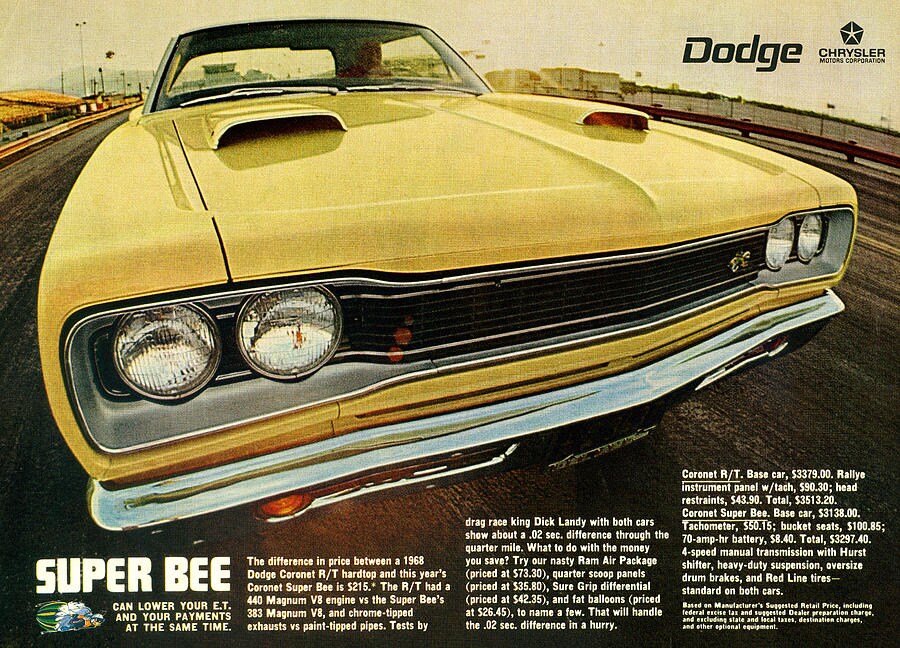
The Dodge Coronet is a classic staple in the car industry and had the famous Super Bee name attached to it as a trim level. The Dodge Coronet was a car marketed by Dodge in seven different generations. It was introduced as a full-size car in 1949 and it was the division's highest trim line. It then moved to the lowest level starting in 1955 through 1959. The name was reintroduced in 1965 and ran on cars until the 1976 model year. Muscle car versions were available starting in 1965 and in 1966 the Chrysler Hemi was attached to some muscle car models. Coronet is a type of crown worn by royalty, so when this car turned into a muscle car, we think no one was surprised.
The Dodge Coronet was introduced with one of the first postwar body styles after World War 2. The Dodge Coronet was a smooth-running car, and the six-cylinder engine could power the car to 90 mph originally. That changed once it became a muscle car. One of the most influential features of the first-generation of the Coronet was a fluid-driven semi-automatic transmission that was called the Gyromatic.
All Dodge vehicles received a facelift for 1950 to get rid of the stockier and more boxy looking cars of the World War 2 era. The 1950 models could be more easily identified by it’s new grille design, which featured 3 heavy horizontal bars, something that Dodge and Chrysler still play with today.
The Coronet and similar Plymouth Belvedere received complete redesigns in the late 60’s, just like their brother the Dodge Charger. They all shared the B-body platform and there was a facelift in 1970. This is where the Coronet gets fun....the Coronet Super Bee was introduced in 1968 as a friend to the Plymouth Road Runner. With Dodge a step above Plymouth, the Super Bee shared the Charger's Rallye instrument cluster and the Coronet 440's rear finish panel. Of course it had a Hemi.
The base Coronet and Deluxe were available as 2-door coupes, 4-door sedans, or station wagons. The base Coronet was dropped in 1969 and left the Deluxe as the lowest trim level. The Coronet 440 convertible exited left in 1968 as well.
In the 70’s, the Super Bee was available as a 2-door coupe or 2-door hardtop. Chrysler eventually displayed a convertible with Super Bee stripes at car shows in 1968, but never offered it as a production model, but more or less a pipe dream.
The original Super Bee was based on the Dodge Coronet, a 2-door model, and was produced from 1968 until 1970. It was Dodge's low-priced muscle car, the equivalent to Plymouth Road Runner, also available with the Hemi engine. The Super Bee included a heavy-duty suspension, high-performance tires, and a stripe with the bee logo wrapped around the tail. The name "Super Bee" was taken from the "B" Body designation given by Chrysler's mid-size cars.
1976 was the final model year for the Dodge Coronet and its body style choices were reduced to a four-door wagon and four-door sedan. The former Dodge Coronet 2-door model was replaced by the Dodge Charger Sport for the 1976 model year. In the 1977 model year, the mid-size Dodge Coronet was renamed Monaco, and the full-size Dodge Monaco was renamed Royal Monaco.
The Dodge Coronet is a long sought after collector item, often seen (and drooled at) during car shows. The Dodge Coronet Super Bee was a muscle car that lives in car history forever!